Threat Intelligence Query Examples - Real World Queries for Identifying Malware Infrastructure
An informal page for storing Censys/Shodan queries
An informal page for storing Censys/Shodan queries
An informal page for storing Censys/Shodan queries that have returned interesting results.
Including examples for -
Hardcoded values in x509 certificates used for TLS communication.
services.tls.certificates.leaf_data.subject.common_name:"AsyncRAT Server" or services.tls.certificates.leaf_data.issuer.common_name:"AsyncRAT Server"(Link)
Commonalities between ssh host key and running ports. Typically only ports 22 and 80. SSH host key is the primary piece here.
services:(ssh.server_host_key.fingerprint_sha256 = "c655bae831ca57a857b26d76a7c98a56a65d00fdab7d234a64addf8166e3cd09" and port = 22) and services:(service_name:HTTP and port:80) and not services.port:993Qakbot C2's masquerading as a slack-related site. It is also possible that this is Pikabot which uses similar tactics.
not dns.reverse_dns.names:* and services.http.response.html_title:"Slack is your productivity platform | Slack"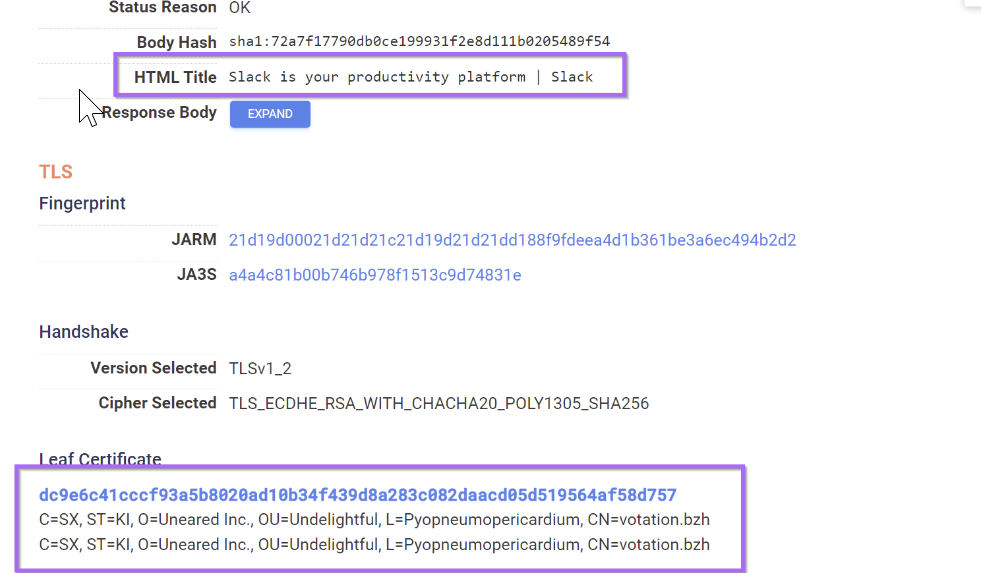
Very generic Cobalt strike indicators based on default certificate values. Likely very unsophisticated actors.
services.tls.certificates.leaf_data.issuer.common_name="Major Cobalt Strike" (Link)services.tls.certificates.leaf_data.issuer.organization="cobaltstrike" (Link)services.tls.certificates.leaf_data.issuer.organizational_unit="AdvancedPenTesting" (Link)services.tls.certificates.leaf_data.subject.province="Cyberspace" and services.tls.certificates.leaf_data.subject.country="Earth" (Link)ssl.cert.subject.cn:"Major Cobalt Strike" (Link)ssl.cert.issuer.cn:"Major Cobalt Strike" (Link)At least two of these servers are related to Remcos rat. There is a re-used ssh host key that is also related to Jupyter/Solarmarker.
services:(ssh.server_host_key.fingerprint_sha256 = "c655bae831ca57a857b26d76a7c98a56a65d00fdab7d234a64addf8166e3cd09" and port = 22) and services:(http.response.html_title:hestia)Re-used CN name in TLS certificates, as well as unique and re-used HTTP response body containing Russian swear words. Full Analysis Here.
services.tls.certificates.leaf_data.subject.common_name:"desas.digital"services.http.response.body_hash:"sha1:e084a66d16925abf43390c59d783f7a2fb49752d"Re-used CN name used in TLS certificates. Full Analysis Here.
services.tls.certificates.leaf_data.subject.common_name: "Quasar Server CA"(Link)
Re-used CN name used in TLS certificates. Full Analysis here.
services.tls.certificates.leaf_data.subject.common_name:"Laplas.app" or services.tls.certificates.leaf_data.issuer.common_name:"Laplas.app"Re-used CN names in TLS certificates. Twitter Post
services:(tls.certificates.leaf_data.subject.common_name:multiplayer and tls.certificates.leaf_data.issuer.common_name:operators)Default HTML Titles, favicon hash and CN name.
(services.http.response.html_title="Mythic") or services.http.response.favicons.md5_hash="6be63470c32ef458926abb198356006c" or services.tls.certificates.leaf_data.subject.common_name="Mythic"Queries based on "Viper" string in html title and response. Not 100% sure what viper is.
A lot of Viper servers seem to have cobalt strike running on alternate ports.
http.html_hash:-1250764086 (Link)+http.title:"viper" +http.html:viper +"Content-Length: 69" (Link)services.http.response.favicons.md5_hash="a7469955bff5e489d2270d9b389064e1" (Link)services:(http.response.html_title:"Viper" and http.response.body:Viper and http.response.headers.content_length:69) (Link)Overlapping ja3s and lack of issuer/common names in certificate.
Unconfirmed if all are cobalt strike but at least a few were sucessful hits.
services:(tls.ja3s:475c9302dc42b2751db9edcac3b74891 and tls.certificates.leaf_data.subject.common_name="" and tls.certificates.leaf_data.issuer.common_name="")Open directories residing on port 8000 and containing at least one .exe file. Reasonable number of false positives, but a lot of interesting results. eg servers containing revshell.exe and similar.
services:(http.response.html_title:"Directory Listing" and http.response.body:*.exe and port:8000) and not services.port:53 and not services.port:[10000 to 65535]Open directories containing references to netcat nc.exe
services.http.response.body:"nc.exe" or services.http.response.body:"ncat.exe"Open Directories Containing references to attack tooling. procdump.exe , nc.exe, ngrok.exe etc.
services.http.response.body:"procdump.exe" or services.http.response.body:"nc.exe" or services.http.response.body:"shell.exe" or services.http.response.body:"revshell.exe" or services.http.response.body:"cs.exe" or services.http.response.body:"chisel.exe" or services.http.response.body:"impacket" or services.http.response.body:ngrok.exeOpen directories containing a file with .ps1 extension. Most of these contain suspicious Powershell scripts.
services:(http.response.body:*.ps1 and http.response.html_title:"Directory Listing" and banner:Python)services:(http.response.html_title:"Directory Listing" and http.response.body:?.ps1)(Single char .ps1 name)
Open directories with references to Anydesk (remote access tooling). Typically in the form of anydesk.exe or anydesk.bat and coupled with other suspicious files.
services:((http.response.body:anydesk.*) and http.response.html_title:"Directory listing")Open directories containing .exe files with single or double character exe names.
services:(http.response.html_title:"Directory Listing" and http.response.body:??.exe)services:(http.response.html_title:"Directory Listing" and http.response.body:?.exe)Suspicious single-character .bat files inside of open directories. eg 1.bat
services:(http.response.html_title:"Directory Listing" and http.response.body:?.bat)Open directories containing a .exe file and at least one of .vbs,.ps1,.bat. Mostly malicious.
services:(http.response.body:.exe and (http.response.body:.vbs or http.response.body:ps1 or http.response.body:.bat) and http.response.html_title:"Directory Listing")Dynamic dns resolving to protonVPN instances. Observed with AsyncRAT fresh03.ddns[.net] resolving to (VPN) 46.166.182[.]34. Difficult to confirm the nature of results as minimal services are running and port forwarding likely used.
services.tls.certificates.leaf_data.subject.common_name:*protonvpn.net and dns.names:*.ddns.netCommon patterns in http responses for WhiteSnake stealer control panels.
Original IP that inspired query is from RussianPanda's blog.
services:(http.response.body:DutchCoders and http.response.body:keybase and http.response.body:Virustotal)Malware Analysis and Threat Intelligence Research
No spam. Unsubscribe anytime.